


What is Phoslock?
Phoslock® was developed in Australia by the Commonwealth Scientific and Industrial Research Organisation (CSIRO) in the late 1990s as a tool to manage phosphorus in lakes and other water bodies. It is a lanthanum-modified bentonite clay designed to bind free reactive phosphorus in the water column and at the sediment–water interface.
The active component in Phoslock® is lanthanum, which has a strong and selective affinity for phosphate. When phosphate comes into contact with lanthanum, a stable, insoluble and biologically inert mineral (rhabdophane), a bond is formed resulting in its permanent removal from both water column and sediment. This process removes reactive phosphorus from circulation within the aquatic system.
Phoslock® is composed of approximately 95 % bentonite clay and 5 % lanthanum.
Phoslock® technology does not measurably alter the pH or electrical conductivity of the receiving water when applied at recommended doses, as demonstrated through peer-reviewed science and field experience since its commercialisation in 2002. Maintaining stable pH is important because it underpins chemical equilibria, regulatory compliance and treatment performance.
Similarly, conductivity is a key indicator of dissolved ionic content and is routinely monitored in drinking water reservoirs, recreational waters and sensitive aquatic environments.
Phoslock® integrates into existing water chemistry without the need for buffering or secondary water chemistry adjustments.
Phoslock® is supplied as a dry granulated material, making it straightforward to transport, store and apply using standard equipment commonly employed in lake and reservoir management. The technology can be applied across a wide range of natural aquatic environments, including lakes, rivers, estuaries, dams, ornamental ponds and natural wetlands, as well as engineered and managed systems, such as wastewater effluents, industrial process waters, and as a phosphorus-binding barrier within containment cells for materials with leachable phosphorus.
In accordance with the EU Classification, Labelling and Packaging (CLP) Regulation and REACH requirements, Phoslock® is not classified as hazardous and is not regulated as dangerous goods for transport.
Jump to:
How is Phoslock applied to a water body
How does Phoslock work?
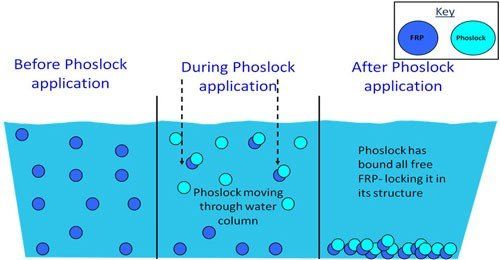
Phoslock works by utilising the ability of lanthanum to react with phosphate. Removal of phosphate by lanthanum is highly efficient and has a molar ratio of 1:1 which means that one ion of lanthanum will bind with one ion of phosphate. This binding forms the mineral Rhabdophane (an insoluble and biologically inert compound) which strips phosphate from the water.
What happens to Phoslock when it has been applied?
How much phosphate does Phoslock remove?
Considering an application of Phoslock?
Every water body is unique, and a robust understanding of site-specific conditions is essential when considering a Phoslock® application. This includes identifying the dominant sources of excess nutrients within the system. Phosphorus may originate from internal sources, such as release from bottom sediments, or from external sources, including diffuse or point inputs from the surrounding catchment. Understanding the relative contribution of these sources is critical, as sustained high external phosphorus loads may influence the role of any in-lake phosphorus management measure.
Water quality data plays a central role in building this understanding. While long-term monitoring records are not always available, routine water quality monitoring provides valuable insight into nutrient dynamics, system behaviour, and management pressures where nutrient enrichment and symptoms of eutrophication, such as recurring algal blooms, have become a concern. These data also help determine whether a phosphorus-binding approach is appropriate for a given site, as multiple physical, chemical and operational factors must be considered prior to any application.
In many cases, sediment sampling is also required to assess the quantity of phosphorus that may be released from the lakebed under prevailing conditions. This information, combined with water column data and site-specific calculations, is used to inform an evidence-based Phoslock® dose design.
If you are considering Phoslock® for your water body, or would like further information, please get in touch. We can provide technical guidance, undertake pre-treatment assessments, and develop indicative dose calculations and cost estimates tailored to your site.
Safety Data Sheet
For detailed information on handling, storage, personal protection, transport and regulatory status, please download the Phoslock® Safety Data Sheet. The current SDS identifies the product as Phoslock Granules / Powder, with bentonite, lanthanum modified listed as the main ingredient, and notes that it is not classified as a hazardous chemical under the cited Australian regulations.





 by
by